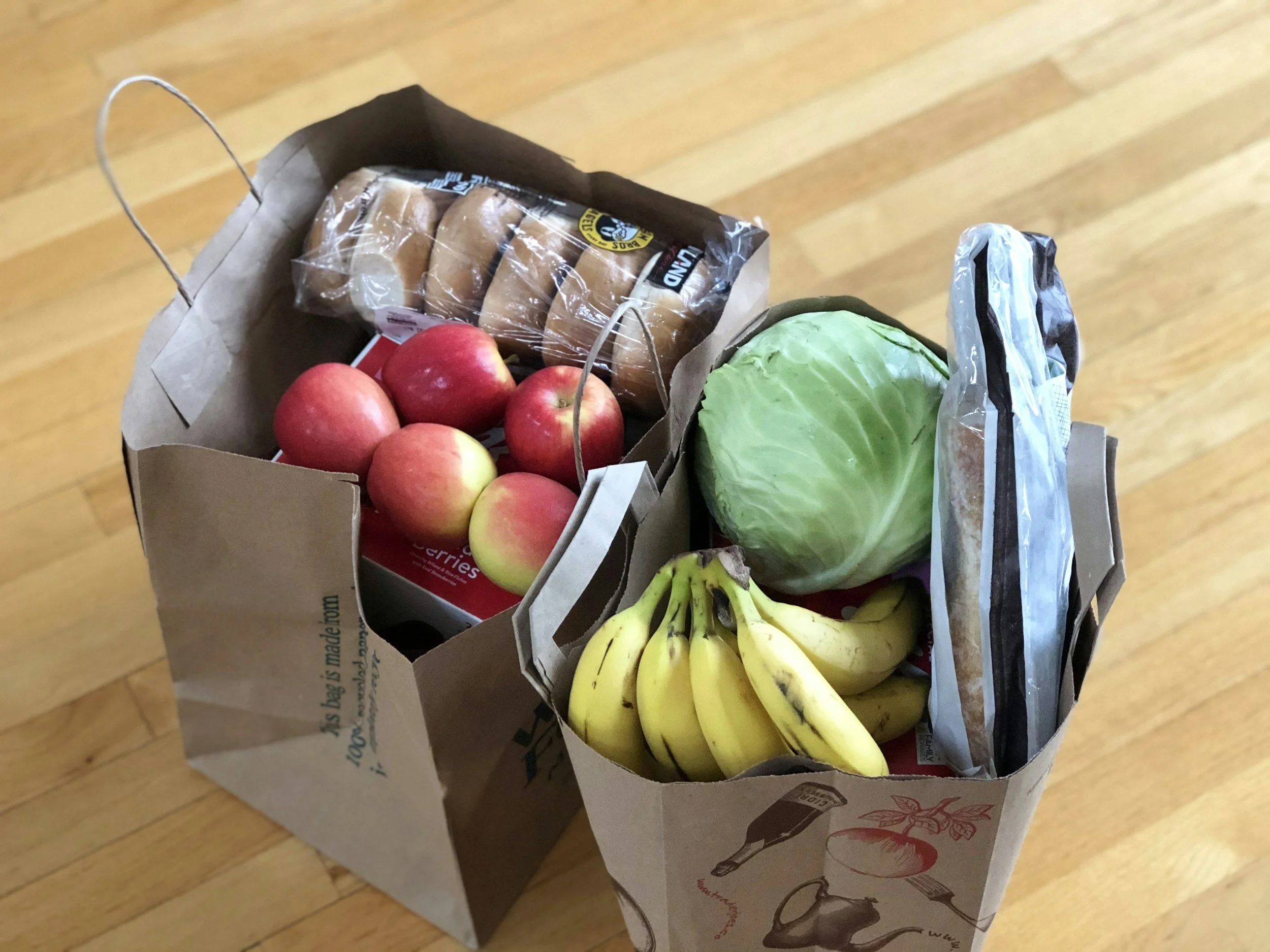
Open Cupboard is serious about making sure that economically fragile people have enough to eat. They’re also serious about making sure fresh, nutritious food, that would otherwise get thrown out, gets to people who need it. As Jessica Francis, Open Cupboard’s executive director, explained to me, if someone doesn’t have enough to eat and they come to one of Open Cupboard’s four food distribution programs, they will go home with good food.
For much of its existence, Open Cupboard provided shoppers with an array of shelf-stable food. But they knew their shoppers wanted more fresh-food options, so a few years ago they made the decision to make fresh foods the focus of their programs. Today, Open Cupboard partners with 19 different stores and the St. Paul Farmer’s Market to rescue food that would otherwise be thrown out.
Bags of salad, eggs, meat, poultry, fruits, vegetables, milk, cheese and baked goods end up going home with people who would not be able to afford such items. Jessica says the food needs to be moved fast, but they have no problem doing that with 1,300 people shopping with them each day. Open Cupboard’s four options for shopping are: Today’s Harvest, their free market in Oakdale, and Maplewood, MN; their Drive-Up program; ten mobile food sites located in the east metro; and their delivery program for anyone living within a certain radius and facing transportation barriers.
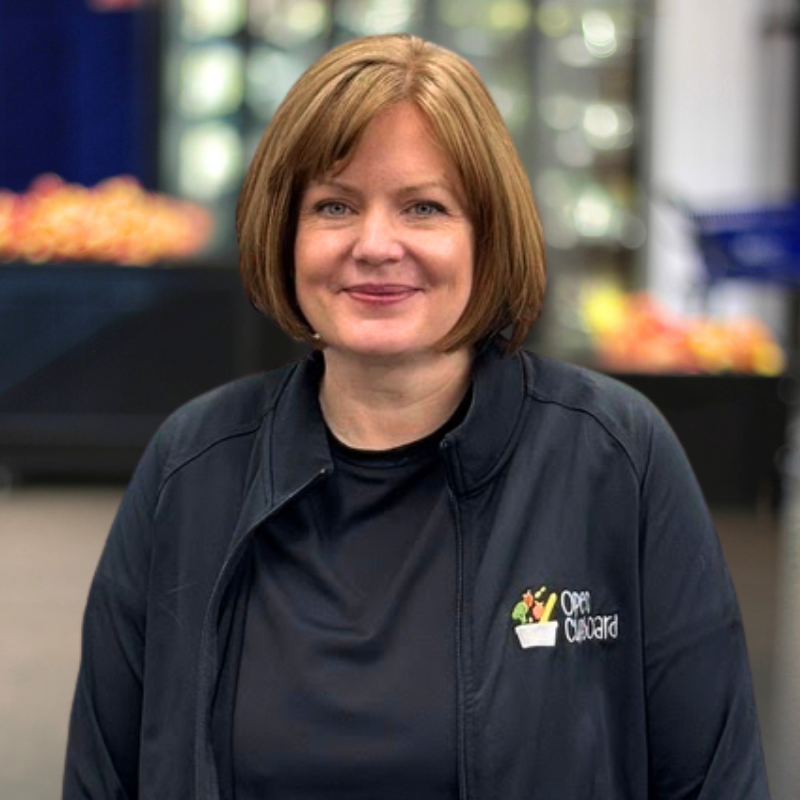
Jessica Francis, Open Cupboard’s Executive Director
Photo Credit: Open Cupboard
Seeds for Changing
Jessica became the executive director at the end of 2019. She brought close to 25 years of experience working to end hunger in Minnesota to that role, including time spent at Hunger Solutions MN, which provides funding and programming to food shelves across the state. Listening to her talk about her work, it’s clear that it’s not just a job but her vocation. In addition to serving as Open Cupboard’s executive director, she is also on the board of St. Croix Valley Food Bank in Hudson, WI.
Her commitment and experience proved invaluable in helping to navigate the challenges of the pandemic that started only a few months after she began working at Open Cupboard. In the spring of 2020, when shoppers could no longer come in to get food, staff and volunteers packed boxes of food, which they distributed to as many people as possible. It was during this difficult time that the seeds for changing their programs to emphasize fresh foods were planted.
Their programs weren’t the only thing to change in the last few years. They also changed their name. Open Cupboard started in 1983 as Christian Cupboard Emergency Food Shelf. Four years ago, they started a renaming process that resulted in them becoming Open Cupboard. Jessica explained that from its beginning, Open Cupboard was open to anyone needing food regardless of their faith. But having the word “Christian” in their name meant they sometimes had to explain and reassure that non-Christians were as welcome as Christians. Changing their name wasn’t easy. There are people who are disappointed by the change. But the new name sends the message that they are open to all and eliminates the need to explain and reassure.
The Unexpected
When asked what most people often get wrong about food insecurity, Jessica says we assume that if someone has a job, they can afford to feed themselves and their family, but that just isn’t true. Many of the people who shop at Open Cupboard are working, but they don’t earn enough to cover all their basic needs, and they earn too much to qualify for government programs. When money is tight and hard choices need to be made, buying groceries is something too many people forgo. A lot of the people shopping at Open Cupboard never expected to have to use a food shelf. A month earlier, they were buying their groceries. But an unexpected expense - medical, car repair, housing - left them with little to no money to feed themselves.
Transportation is another challenge people experiencing food insecurity often face that most of us don’t understand. Having access to a car or public transportation can be the difference between eating and going hungry for many. Open Cupboard has a delivery service and a mobile foodshelf program to bring food to people who can’t come to them. Jessica says the demand for both programs is far greater than what they can provide. Transportation is a big issue in addressing food insecurity, but it isn’t always a priority for funders and policymakers.
The unexpected can make the difficult work of addressing food insecurity even harder. Last November, when SNAP benefits were withheld by the current administration, 1,300 first-time shoppers showed up to get food from Open Cupboard in two weeks. During Operation Metro Surge, ICE agents were in their parking lot in Oakdale. They never entered their building, but their presence was enough to make staff, volunteers and shoppers feel threatened. Jessica shared that one of their team members began carrying his passport with him throughout his shift in case he was stopped by ICE.
The Weight of the World
But even with all the things that are hard about their work, Jessica says there is a lot to be hopeful about. There is a general trend among food shelves across the state to make fresh foods more available. The staff, board and volunteers are united in their “unrelenting focus to provide nutritious food to our neighbors in a respectful manner while engaging our community in the fight against hunger.” There are volunteers who show up and give generously of their time because they want to be a part of bringing an end to food insecurity. While other volunteers are there to pay it forward, having experienced food insecurity in the past.
There is no shortage of shame when it comes to food insecurity. People who can’t feed themselves and their families often feel too much shame to talk about it. It will make a parent go hungry so their child has enough to eat. And it can keep someone from going to a food shelf to get food. Shame, along with the assumption that getting food from a shelter will be a horrible experience, allows food insecurity to thrive. That is why Open Cupboard works hard to be welcoming and challenge the assumptions people have about what it is like to get food from them. Jessica says that to see someone show up to get food with the weight of the world on their shoulders, and to see them leave with good food feeling lighter and more hopeful. It changes the trajectory of their day.
Learn More
Visit Open Cupboard’s website to learn more about their programs, ways to support them, including making a tax deductible gift, and meet some of their shoppers.
Here is an overview of why it is harder for people to cover the cost of their basic needs by Dr. Jessica Knurick.